
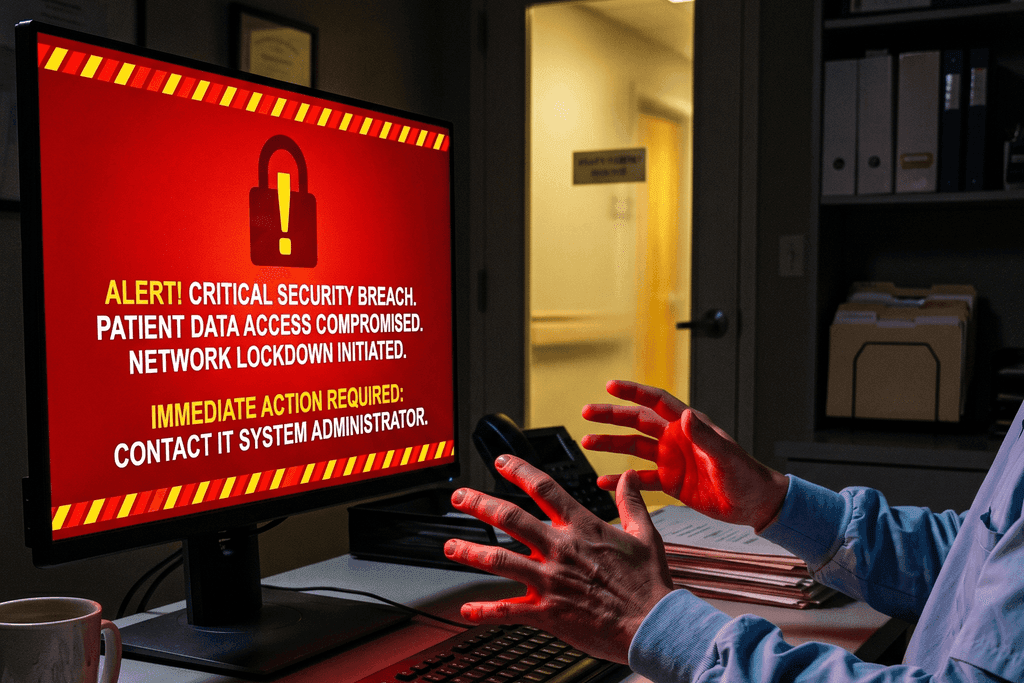
Healthcare is the most targeted industry for cyberattacks — and has been for over a decade. The reason is simple: patient data is worth far more on the black market than credit card numbers, and many medical practices operate with outdated technology and inadequate security.
For medical practices in Florida, the risks are real and growing. In 2024 alone, healthcare data breaches cost an average of $9.77 million per incident — the highest of any industry for the 13th consecutive year.
The good news is that most cyberattacks are preventable. Understanding the threats is the first step. Here are the 5 cybersecurity threats every medical practice in Florida needs to know about — and exactly what to do about them.
Threat #1 — Ransomware
What it is
Ransomware is malicious software that encrypts your files and holds them hostage until you pay a ransom — typically in cryptocurrency. For medical practices, this means patient records, scheduling systems, billing software, and everything else your practice depends on can be locked in an instant.
Why medical practices are targeted
Attackers know that medical practices can’t afford downtime. When a clinic can’t access patient records, the pressure to pay the ransom is enormous. Healthcare organizations are statistically more likely to pay — making them a prime target.
What it costs
The median ransomware payment in healthcare in 2024 was $1.5 million. But the ransom is just the beginning — add downtime costs, recovery expenses, regulatory fines, and reputational damage and the total can be catastrophic.
How to protect your practice
- 24/7 SOC monitoring — catch ransomware before it deploys
- EDR (Endpoint Detection & Response) — detect and isolate threats on individual devices in real time
- Automated backups — if you’re backed up, you can restore without paying the ransom
- Staff training — most ransomware enters through phishing emails clicked by employees
Threat #2 — Phishing Attacks
What it is
Phishing is a social engineering attack where cybercriminals send emails, texts, or phone calls pretending to be a trusted source — a bank, Microsoft, a colleague, or even your IT provider — to trick employees into clicking malicious links or handing over login credentials.
Why medical practices are targeted
Medical offices are busy environments where staff are constantly handling emails, scheduling requests, and insurance communications. Attackers craft phishing emails that look identical to legitimate messages your staff receives every day.
The numbers
Over 90% of all cyberattacks begin with a phishing email. It is by far the most common entry point for ransomware, data breaches, and business email compromise.
How to protect your practice
- AI-native email security — filters out malicious emails before they reach your staff
- Phishing simulations — regularly test your team with simulated phishing attacks to identify vulnerabilities
- Security awareness training — teach staff to recognize and report suspicious emails
- Multi-factor authentication (MFA) — even if credentials are stolen, MFA prevents unauthorized access
Threat #3 — Business Email Compromise (BEC)
What it is
Business Email Compromise is a sophisticated attack where criminals either hack into or spoof a legitimate email account — often a doctor, office manager, or billing department — and use it to authorize fraudulent wire transfers, redirect payroll, or steal sensitive information.
Why medical practices are targeted
Medical practices handle significant financial transactions — insurance reimbursements, vendor payments, payroll. A single convincing email from a “compromised” account can result in tens of thousands of dollars being transferred to a criminal’s account before anyone realizes what happened.
A real-world example
An attacker compromises the office manager’s email account. They monitor communications for weeks, then at the right moment send an email to the billing department requesting a change in bank account details for a vendor payment. The staff complies — and the money is gone.
How to protect your practice
- Email security with API-based protection — detects account takeovers and anomalous behavior
- Identity Threat Detection & Response (ITDR) — monitors for compromised credentials and unusual login activity
- Multi-factor authentication on all email accounts
- Staff verification procedures — always verify financial requests via phone before acting
Threat #4 — Insider Threats
What it is
Not all threats come from outside your practice. Insider threats include current or former employees, contractors, or business partners who intentionally or accidentally expose, steal, or misuse patient data or practice systems.
Why this matters for HIPAA
Under HIPAA, your practice is responsible for patient data regardless of whether a breach was caused by an external attacker or an internal employee. Insider breaches are just as costly — and often harder to detect.
Common insider threat scenarios
- A disgruntled former employee accessing patient records after termination
- An employee accidentally emailing patient data to the wrong recipient
- A staff member sharing login credentials with a colleague
- A contractor installing unauthorized software on practice computers
How to protect your practice
- Role-based access controls — staff only access the data they need for their job
- Audit logs — monitor who is accessing what data and when
- Offboarding procedures — immediately revoke access when an employee leaves
- Security awareness training — reduce accidental breaches through education
- External footprint monitoring — detect if credentials are leaked or misused externally
Threat #5 — Unpatched Software and Outdated Systems
What it is
Every piece of software — from your operating system to your EHR platform — has vulnerabilities. Software vendors release patches and updates to fix these vulnerabilities. When practices fail to apply updates promptly, they leave known security holes open for attackers to exploit.
Why medical practices are vulnerable
Medical practices often run legacy systems — older versions of Windows, outdated EHR software, or unsupported network equipment — because upgrading feels disruptive or expensive. Attackers specifically target known vulnerabilities in outdated software because the exploits are well-documented and easy to execute.
A sobering fact
The infamous WannaCry ransomware attack that crippled the UK’s National Health Service in 2017 exploited a Windows vulnerability that Microsoft had already released a patch for. The systems that were hit simply hadn’t been updated.
How to protect your practice
- Automated patch management — ensure all software is updated promptly without disrupting clinic operations
- Network monitoring — identify outdated or vulnerable devices on your network
- Regular security assessments — proactively identify vulnerabilities before attackers do
- Hardware lifecycle management — replace end-of-life equipment before it becomes a liability
How Concierge IT Protects Medical Practices in Florida
At Concierge IT, every one of these threats is addressed in our flat-rate managed IT plan:
| Threat | Our Solution |
|---|---|
| Ransomware | 24/7 SOC, EDR, automated backups |
| Phishing | AI-native email security, phishing simulations, security awareness training |
| Business Email Compromise | ITDR, API-based email protection, MFA |
| Insider Threats | Access controls, audit logs, external footprint monitoring |
| Unpatched Software | Automated patch management, network monitoring |
All of this is included in our flat rate of $90 per user per month and $20 per device per month — no add-ons, no surprises, no long term contracts.
We also offer a free Cybersecurity Audit for any medical practice in Palm Beach County and the Treasure Coast — no obligation required. You’ll get a clear picture of where your practice stands and exactly what needs to be addressed.
Call (561) 807-3305, email Info@GetConciergeIT.com, or visit our Pricing & FAQ page to learn more.
Frequently Asked Questions
Q: Is healthcare really the most targeted industry for cyberattacks?
Yes. Healthcare has been the most targeted industry for data breaches for over a decade, primarily because patient data is highly valuable and many practices operate with inadequate security.
Q: How much does a healthcare data breach cost?
The average cost of a healthcare data breach in 2024 was $9.77 million — the highest of any industry. This includes regulatory fines, legal fees, notification costs, downtime, and reputational damage.
Q: What is the most common way hackers get into medical practices?
Phishing emails are the #1 entry point, accounting for over 90% of all cyberattacks. Training your staff to recognize phishing attempts is one of the most effective defenses.
Q: Does Concierge IT include cybersecurity in their base plan?
Yes. Our full Guardz cybersecurity suite — including EDR, 24/7 SOC monitoring, email security, phishing simulations, ITDR, and external footprint monitoring — is included in our flat rate of $90 per user per month. No add-ons required.
Q: How do I know if my practice has already been compromised?
Many breaches go undetected for months. The best way to find out is a professional cybersecurity audit. Concierge IT offers a free Cybersecurity Audit for medical practices in Palm Beach County and the Treasure Coast — call (561) 807-3305 to schedule yours.
Concierge IT is a Jupiter, FL based managed IT provider specializing in healthcare practices across Palm Beach County and the Treasure Coast. Contact us at (561) 807-3305 or Info@GetConciergeIT.com.

Chris Jeanguenat is the co-founding CEO of Concierge IT, bringing over 20 years of healthcare IT experience to medical practices across Palm Beach County and the Treasure Coast.